
- Adobe Premiere Elements 2020 Features Free
- Adobe Premiere Elements 2020 Features List
- Adobe Premiere Elements 2020 Review
- Adobe Premiere Elements 2020 Features Free
Adobe’s Creative Cloud apps are top-rated for their powerful capabilities, but their high price, subscription-only model, and complex user interfaces leave a lot of users cold. For those who want to leverage Adobe’s technology in a more-approachable way, the company continues to pack features into its Elements Suite. The 2020 versions of Photoshop Elements and Premiere Elements, available this week, continue to add new capabilities, mostly thanks to Adobe’s brand of AI that it calls its Sensei technology. We had some time to test each; here are our initial impressions.
Apart from the fact that Adobe Premiere Elements 2020 cuts, slices and dices video footage and allows you to create your projects in all the popular formats here is a rundown of some of the features. To see all of it you should go to the Adobe site and check it out and there is a link at the end of this page. Features of Adobe Premiere Elements 2020. Slideshow of photos and videos and collages created for you to highlight memorable moments.
Frankly, Elements 2020 looks a lot like Elements 2019 and 2018. If you’re familiar with any recent version of Elements, you’ll easily be able to navigate this one. The only new learning required is locating the new features. While the UI is looking quite dated, it is well thought out and continues to have the advantage of clearly separating Quick, Guided, and Expert modes.
New Features in Photoshop Elements 2020
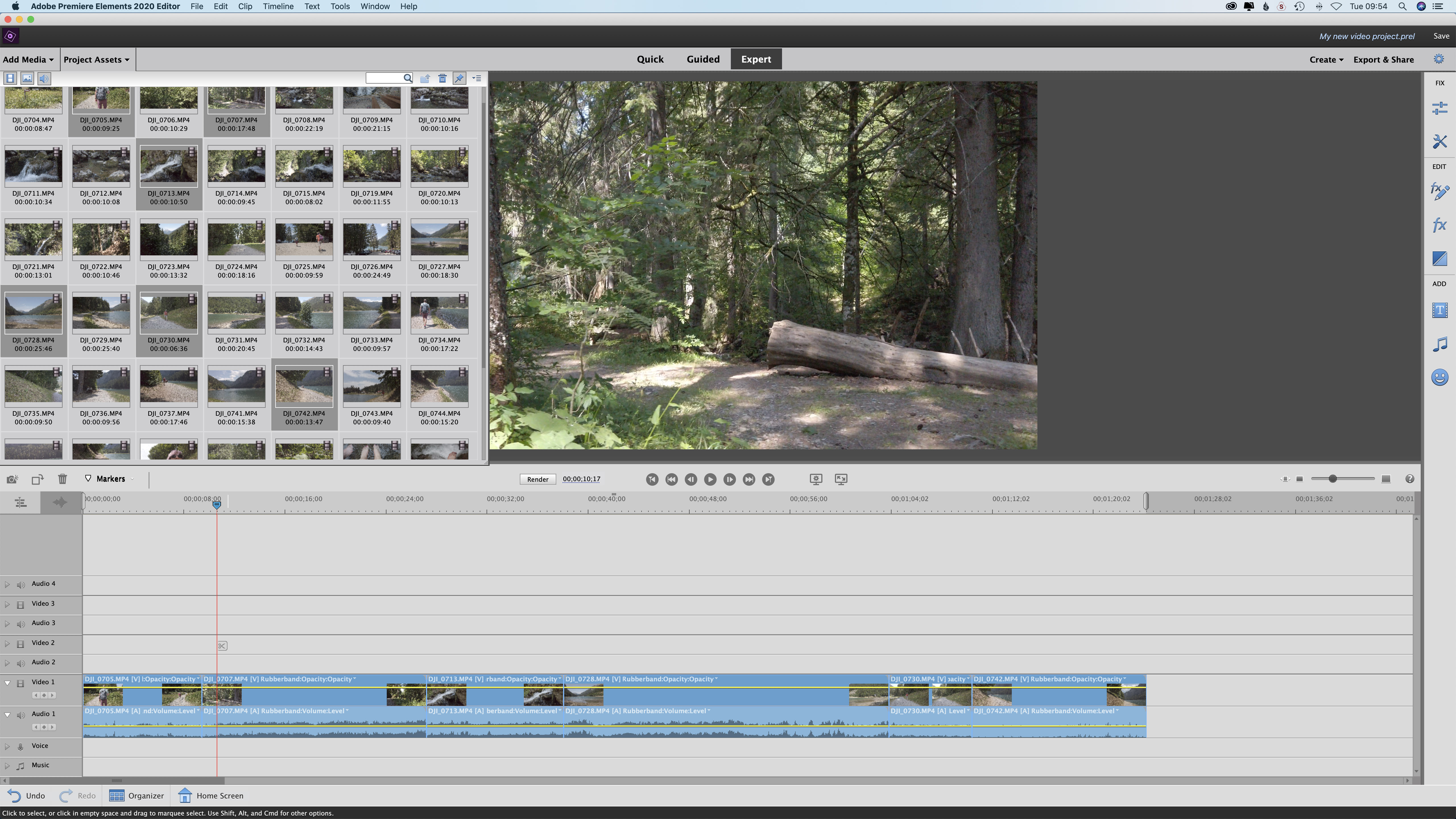
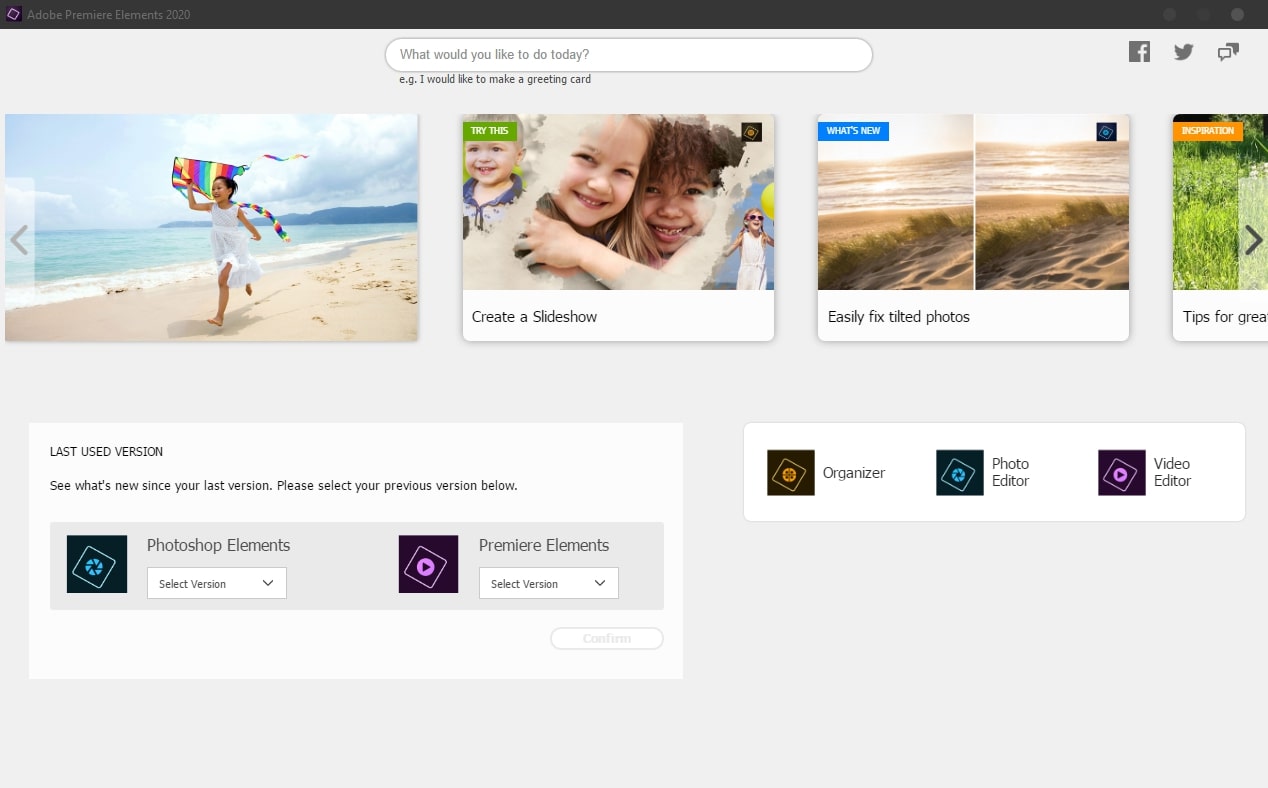
New features in Elements run the gamut from cute — like adding fun patterns to images and ordering prints and gifts — to workmanlike — faster performance and HEIF/HEVC support. Several, including skin smoothing, object removal, automatic colorization, and one-click subject selection, are made possible through Adobe’s Sensei AI technology framework. There is also a new Auto Creations feature that works similarly to the way Google Photos looks for enhancements it can make to your images and presents them to you on a regular basis. In this case, the results are shown to you on the application’s Home screen.

New Features in Premiere Elements 2020
Elements has auto-tagged photos for a while now, but with the 2020 release of Premiere, videos can now also be auto-tagged, including using facial recognition to tag individuals. I’m pretty excited by this, as videos are especially hard to sort through when they’re just sitting in folders, and they tend to have limited metadata compared with photos to begin with. Like Photoshop Elements, Premiere has added support for HEIF and HEVC codecs on both Windows and macOS. Dvb output driver download.
There are also three new Guided Edits: An automatic time-lapse video creation tool, a sky animation tool, and a tool to fill in the background areas that are normally black when you rotate a video between portrait and landscape.
Testing Photoshop’s New Object Removal Capability
Adobe has made the task of removing unwanted elements in a photo easier than ever in Elements 20. A new Object Removal Guided Edit allows you to select what you want to remove using a brush, or automatically in several different ways. If the object is in front of an otherwise consistent background, Elements then uses some AI magic to paint an appropriate replacement for the deleted object. As you’d expect, this does still have limits. Here is an example image that shows how powerful the tool is and its limitations.
First, the “before” image, an HDR I captured of a courtyard in Diocletian’s Palace in Split, Croatia. I loved the site, but had a hard time getting a shot without a lot of tourists in it:
HDR in Diocletian’s Palace, Croatia with plenty of tourists in the scene.
The first, and most important, step in the Object Removal Guided Edit is selecting the area of the image you want removed. I used the Quick Selection tool to pick out a few of the tourists I found most distracting. When I first selected them it also grabbed some of the background, but a quick shift to “Subtract” let me wipe those away. I created selections in both of the lower corners. Here is a screenshot of the selection I made in the lower left:
Quick selection of tourists to remove from the original image
Once you are satisfied with your selection, you tell Elements to replace it with an in-painted region based on other portions of the image. You can further tune the results with a Healing Brush or Clone Stamp. In my case, I just let Elements do the work. You can see in the resulting image below that it does very well with the portions of the tourists that are clearly in front of the tile or a step, but it isn’t perfect at estimating what to use for a replacement where there is less to go on. Of course, corners are the hardest for it, as there is only background on two sides to work with:
HDR of Diocletian’s Palace after using Elements to do a quick replacement of some of the most distracting tourists.
Colorizing an Image in Photoshop Elements 2020
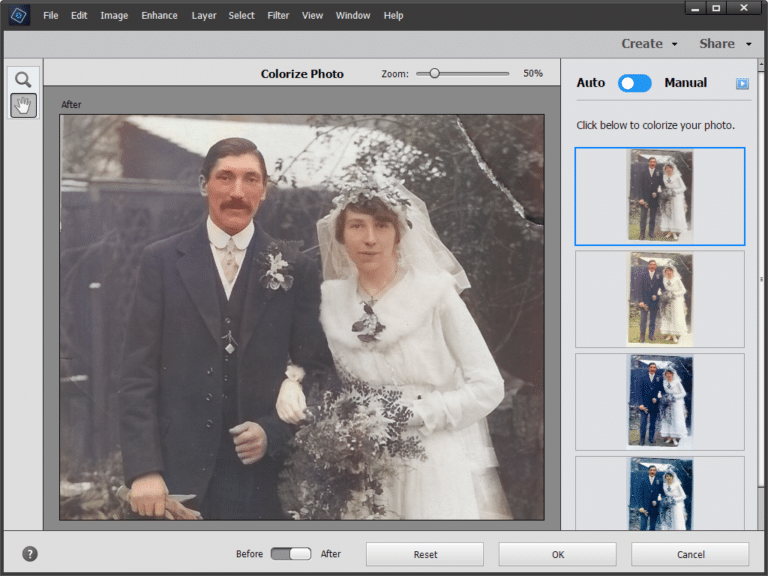
With all the attention that’s been paid to creatively turning color images into artsy black and white versions, it’s easy to forget that there are still a lot of original monochrome images that people wish had been captured in color. Elements 2020 provides a pretty sweet tool for doing just that. Once you find it (it is under the Enhance menu, not a Guided Edit) you simply invoke it and then choose from one of the looks it comes up with.
I decided to give it a try with a 60+-year-old family snapshot from our album. First I used a couple of Guided Edits to clean up the dust and scratches, fix the tones a bit, and sharpen the image. Then I used colorize. One of the looks resembles what an old color photo might have faded to, one is quite saturated like a slide, one is very subtle, and the one I chose seemed the closest to reality.
Here is the original image:
Scan of black and white snapshot from the 1950s.
And here is the final result:
The same image retouched in Photoshop Elements 2020 and cropped slightly.
Having restored old and damaged images for clients manually, I’m quite impressed by what I could do in just a couple minutes using Elements. The difference in color between the foreground and background grass seems extreme, but looking at the original, the lighting is so different that it might well have looked this way if the image had originally been shot in color. With a little more work I could certainly have done more to clean up some of the grain and made the sky more attractive, but this keeps the flavor of the original image while giving it some new life.
Pricing and Availability
Both Photoshop and Premiere Elements are available now and are priced at $100 each. Upgrades are $80 per product. A bundle of the two applications is $150, or $120 for an upgrade. If you purchase the new version of Photoshop Elements every year, it really isn’t much less expensive than a Photoshop + Lightroom subscription, but you certainly get an easier-to-use product that you can keep forever. If you need video editing, then the price benefits are substantial compared with a Premiere Pro or full Creative Cloud subscription. So for those looking for a powerful but economical video editing suite, Elements competes more with CyberLink’s Power Director and Photo Director than it does with Adobe’s own Creative Cloud subscription.
[Image Credit: David Cardinal] Acer viseo 220dx (hdmi) driver download.
Now Read:
| Developer(s) | Adobe Systems |
|---|---|
| Initial release | September, 2004; 15 years ago |
| Stable release | 2019 / October 4, 2018; 2 years ago |
| Preview release | None [±] |
| Operating system | Premiere Elements 2018 Windows (64-bit) Windows 7 SP1 or later[1] Mac OS X 10.11 El Capitan or later[1] Premiere Elements 2019 Microsoft Windows (64-bit) Windows 7 SP1 or later[2] Mac OS 10.12 Sierra or later[2] |
| Available in | Windows Czech, Dutch, English, French, German, Italian, Japanese, Polish, Russian, Spanish, Swedish.MacOS English, French, German, Japanese |
| Type | Video editing software |
| License | Trialware |
| Website | www.adobe.com/products/premiere-elements.html |
Adobe Premiere Elements 2020 Features Free
Adobe Premiere Elements is a video editing software application published by Adobe Systems. It is a scaled-down version of Adobe Premiere Pro and is tailored to novice editors and consumers. The entry screen offers clip organization, editing and auto-movie generation options. Premiere Pro project files are not compatible with Premiere Elements projects files.
While marketed separately, it is frequently bundled for added value with Adobe Photoshop Elements. In 2006, it was identified as the number one selling consumer video editing software.[3] Its main competitors are Final Cut Express (no longer sold), AVS Video Editor, PowerDirector, Pinnacle Studio, Sony Vegas Movie Studio, Sony Vegas, Corel VideoStudio, and iMovie.
Unlike many of its competitors, Premiere Elements can handle unlimited video and audio tracks,[4][5] with multiple keyframe effects applied to each clip, as well as picture-in-picture and chroma key capabilities. It also supports many third-party plug-ins for additional features, including Premiere Pro plug-ins, After Effects plug-ins, and VST effects. It can create bars and tone and a countdown leader, just like Premiere Pro.
This program also features real-time video rendering which allows the user to instantly preview edits made to the video timeline.
Premiere Elements is available for Windows and MacOS. It is not available as part of a creative cloud subscription, but rather as a single purchase or upgrade purchase.[6]
Product history[edit]
- Adobe Premiere Elements 1.0 – Released in September 2004. It was focused on consumer miniDVcamcorder owners who wanted to create DVDs. It was codenamed Dick Tracy after Adobe Premiere's theme of detective code names. The development team for this product was based at Adobe's offices in San Jose, California, Arden Hills, Minnesota, and Noida, India.
- Adobe Premiere Elements 2.0 – Released in September 2005. Adobe expanded video device support beyond DV camcorders to include digital still cameras that capture video (MJPEG, MPEG4, etc.), DVD camcorders (.vob files), mobile phones (.3GP, .3G2) and new hybrid video devices like the JVC Everio and Everio G (.MOD). It also aimed to address the lack of DVD configurability, one of the main criticisms of version 1. Unlike the first version, PE2.0 may not work with AMD processors, or Intel processors that do not support the SSE2 instructions.
- Adobe Premiere Elements 3.0 – Released in September 2006. Adobe added HDV support, stop motion capture, audio narration, full-screen playback, and the ability to capture from WDM sources (such as webcams and analog capture cards). This version improved ease of use by adding Sceneline editing and allowing titles to be created and edited directly in the Monitor. New export formats were added for mobile phones, iPods and PSPs. An updated 3.0.2 version was the first to support Windows Vista, 32-bit only.[7]
- Adobe Premiere Elements 4.0 - Released in September 2007. Adobe added a Sharing Centre, an image stabilization filter and the ability to upload video files directly to YouTube. It also includes more video effects and transitions, a slightly-modified user interface allowing beginners to easily get started with the program (although it still retains unlimited video and audio tracks), the ability to burn Blu-ray DVDs, an audio mixer (like the version on Premiere Pro) and movie themes similar to the ones from iMovie HD 6.[8] This version includes features such as Easily organize your photos and video clips from one convenient place, Organize video clips and photos with visual tags, Create your movie with drag-and-drop ease in the Scene line, Easily edit slide shows and movies to the beat of a favorite song, Jazz up the action with effects, transitions, and movie themes, Add animated titles, motion menus, and polished credits, Share movies on DVD, Blu-ray Disc, and Mobile Devices, & Easily upload to YouTube.
- Adobe Premiere Elements 7.0 - Released in October 2008.[9] The version numbers 5.0 and 6.0 were skipped in order to match Photoshop Elements 7.0 version in the bundle. This version includes AVCHD support, an automatic movie-creation wizard (similar to Pinnacle Studio's SmartMovie and iMovie HD 6's Magic iMovie), a built-in SmartSound music generator (previous versions would only work with SmartSound via a free plug-in downloaded from the SmartSound website), enhanced chroma-key technology, among other features. It still retains the ease of use and prosumer-style technology of Adobe Premiere Elements 4.0. This version includes new features such as View your movies from any web-enabled computer, quickly find your best video clips and photos with the Auto-Analyzer, Enjoy optimized editing, even when working with HD also known as High-Definition, Let Instant Movie automatically create a movie using creative techniques from Hollywood directors, Easily combine elements from different videos for entertaining results, Add musical soundtracks that automatically adjust to match the length of your movie, Easily combine elements from different videos for entertaining results & add musical soundtracks that automatically adjust to match the length of your movie.
- Adobe Premiere Elements 8.0 – Released in October 2009.[10] This version includes a new Easily find, view, and organize videos and photos in the fully featured Organizer, See full-screen video and photo previews in the Organizer, See the same videos and photos on all of your computers with automatic syncing*, Get automatic online backup and 2GB of storage — enough for up to 24 minutes of DVD-quality video†, Get help with how-tos that appear just when you need them†, Have shaky footage and color and lighting problems fixed automatically, Have unwanted footage trimmed automatically, Use automated options to intelligently balance audio elements, Use motion tracking to add graphics that automatically move with the subjects in your scenes, & Add graphics, frames, and animations from a clip art library. media manager view, several features aimed at automatically compensating for video problems such as camera shake, and support for Windows 7 and Windows Touch, among other features.
- Adobe Premiere Elements 9.0 – Released in September 21, 2010 for Windows and MacOS. This version includes a new ability to import clips from compact camcorders like Flip cameras as well as from DSLR still cameras, Easily fix audio problems, and create new effects. This version also gives the user the ability to easily create a convenient web DVD viewing experience, along with older version features.
- Adobe Premiere Elements 10.0 – Released in September 19, 2011 for Windows and MacOS. Among this version's new features is the ability directly upload videos to Facebook or YouTube. (64-Bit Ready)
- Adobe Premiere Elements 11.0 – Released in September 25, 2012 for Windows and MacOS. Changes in this version are: improved user interface, new effects and Vimeo upload. (64-Bit Ready)
- Adobe Premiere Elements 12.0 – Released in September 23, 2013 for Windows and MacOS. Changes in this version are: new effects, Motion Tracking
- Adobe Premiere Elements 13.0 – Released in September 23, 2014 for Windows and MacOS. Changes in this version are: video stabilizer, more guided edits, video story. DV and HDV capture is removed.
- Adobe Premiere Elements 14.0 – Released in September 24, 2015 for Windows and MacOS. Changes in this version are: motion titles, color pop, guided edits, 4K Ultra HD.[11]
- Adobe Premiere Elements 15 – Released in October 4, 2016 for Windows and MacOS. Changes in this version are: Layer Adjustment, a Guided Edit which applies effects across multiple clips or an entire movie at once; Haze Removal; remixing of music files to fit video clip length; face detection in Smart Trim, Favorite Moments and Pan and Zoom; Video Collage, a tool for the creation of dynamic collages with photos and video.[12]
- Adobe Premiere Elements 2018 – Released in October 4, 2017 for Windows and MacOS. Changes in this version are: Candid Moments, Smart Trim, Freeze Frame with Motion Title, Create Bounce Back Effect, Animated Social Posts, Fix Action Cam Footage, One-click dynamic slideshows.[13]
- Adobe Premiere Elements 2019 – Released in October 4, 2018 for Windows and MacOS. This version introduced a redesigned Home Screen which, upon launch, delivers automatically created photo and video slideshows and collages (Auto Creations) and features personalized content, 2 new Guided Edits, support for the import and editing of High Efficiency Image File Format and High Efficiency Video Coding media, the ability to export GIFs on MacOS, the ability to auto-synchronize audio with video captured at a Variable Frame Rate (VFR), new templates and a completely redesigned and easier to use Quick Edit mode. Direct share on Facebook, as well as support for Flash files, DVD (only on MacOS) and QuickTime format have been removed.[14][15]
See also[edit]
Adobe Premiere Elements 2020 Features List
References[edit]
Adobe Premiere Elements 2020 Review
- ^ ab'System Requirements'. Adobe Premiere Elements system requirements. Adobe Systems. Retrieved March 6, 2019.
- ^ ab'System Requirements'. Adobe Premiere Elements system requirements. Adobe Systems. Retrieved March 6, 2019.
- ^'Adobe Photoshop Elements 12 - FAQ'. Adobe Systems, Inc. July 11, 2013. Retrieved April 30, 2014.
- ^'Computer Shopper'. Dennis Publishing Ltd. Archived from the original on March 24, 2008. Retrieved April 30, 2014.
- ^Steve Paris (October 8, 2013). 'Adobe Premiere Elements 12 review- Video editing software Reviews- TechRadar'. Future US, Inc. Archived from the original on February 11, 2014. Retrieved April 30, 2014.
- ^'Easy Video Editor & Movie Maker Software | Adobe Premiere Elements 2020'. www.adobe.com. Retrieved September 9, 2020.
- ^'Adobe Premiere Elements 3.0 requirements page'. Archived from the original on January 29, 2009. and Adobe Premiere Elements 3.0.2 update page with requirements
- ^'Adobe Premiere Elements Upgrade details'. Archived from the original on May 26, 2008.
- ^'Adobe Premiere Elements v7.0'. October 2008. Retrieved December 10, 2014.
- ^'Adobe Premiere Elements 8 [OLD VERSION]: Software'. Retrieved October 20, 2013.
- ^Gager, Bob (September 24, 2015). 'Introducing Adobe Photoshop Elements 14 & Premiere Elements 14'. Photoshop Blog. Adobe. Retrieved August 18, 2017.
- ^Staff (October 4, 2016). 'Introducing Adobe Photoshop Elements 15 & Premiere Elements 15'. Photoshop Blog. Adobe. Retrieved August 18, 2017.
- ^'Introducing Adobe Photoshop Elements 2018 & Premiere Elements 2018 | Adobe Blog'. Adobe Blog. October 4, 2017. Retrieved March 7, 2018.
- ^'Introducing Adobe Photoshop Elements 2019 & Premiere Elements 2019'. Adobe Blog. October 4, 2018. Retrieved March 6, 2019.
- ^'What's new in Adobe Premiere Elements'. What's new in Adobe Premiere Elements. March 6, 2019. Archived from the original on March 6, 2019. Retrieved March 6, 2019.
External links[edit]
Adobe Premiere Elements 2020 Features Free